
Since the launch of the metric system in France in 1799, almost all countries around the world have finished metrication, and the International System of Units (SI), the modern form of the metric system, became the most widly-used system of measurement.
There are few unit systems other than SI that are used officially today. A notable case is the United States customary units. Although the United Kingdom where the imperial system of units was developed has officially converted to the metric system, the United States still uses its own unit system derived from English units. Because of the global influence of the United States and its dominant role in some fields such as aviation, displays, and computers, the United States customary units has become the second most important unit system in the world.
0. Imperial vs. US Customary Measurement Systems
Although Both imperial and US customary measurement systems are derived from the English units of measurement, there are noticeable differences between the two systems.
- The types of units used in the two systems are different,
- The definitions of each unit are different.
For example, a foot is
- 0.3048 m in imperial definition,
- 1200/3937 m in US survey definition.
In everyday life, the difference between the two systems is negligible; however, as the scale increases, the difference becomes more pronounced.
In 1958, the US and Commonwealth countries standardized the units of length and weight in both systems based on the metric system. The international standard says that a yard is 0.9144 m and a pound is 0.453 592 37 kg. Though the US customary and international pounds are identical, the two yards are different, and both definitions are mixed in the United States. In order to avoid confusion, the US survey length units are deprecated from January 2023 by the National Institute of Standards and Technology (NIST), and this post follows the international length units.
Unless otherwise noted, all other units are described based on the United States customary units.
1. Length
US survey units not defined in the international units are colored in red.
Regular Length
| Symbol | Unit | Divisions | Remarks |
|---|---|---|---|
| p | point | 1/12 P̸ | For measuring font size |
| P̸ | pica | 1/6 in | For measuring columns and margins |
| in | inch | 25.4 mm | Width of a thumb |
| li | link | 33/50 ft | Length of a segment in Gunter’s chain |
| ft | foot | 12 in | Length of a foot |
| yd | yard | 3 ft | Length of an arm |
| rd | rod | 25 li | Length of a medieval cattle prod |
| ch | chain | 4 rd, 22 yd | Length of Gunter’s chain |
| fur | furlong | 10 ch | Distance a team of oxen could plough without resting |
| mi | mile | 1760 yd, 8 fur | Distance of a thousand walking steps |
| lea | league | 3 mi | Distance a person could walk in an hour |
To summarize:
(12 in = 1 ft) → (3 ft = 1 yd) → (22 yd = 1 ch) → (10 ch = 1 fur) → (8 fur = 1 mi)
Nautical Length
| Symbol | Unit | Divisions | Remarks |
|---|---|---|---|
| ftm | fathom | 2 yd | For measuring the depth of water |
| cb | cable | 120 ftm | Historic length of a ship’s cable |
| NM | nautical mile | 1852 m | Length of the meridian corresponding to 1 minute latitude |
2. Area
Land Area
| Symbol | Unit | Divisions | Remarks |
|---|---|---|---|
| sq ft | square foot | 12 in × 12 in = 144 sq in | For measuring the area of a building or yard |
| sq yd | square yard | 3 ft × 3 ft = 9 sq ft | |
| sq ch | square chain | 22 yd × 22 yd = 484 sq yd | |
| ac | acre | 1 fur × 1 ch = 10 sq ch | Land tillable by a team of eight oxen in a day |
| section | section | 1 sq mi, 640 ac | A square made of acres |
| twp | township | 6 mi × 6 mi = 36 section | Local administrative division |
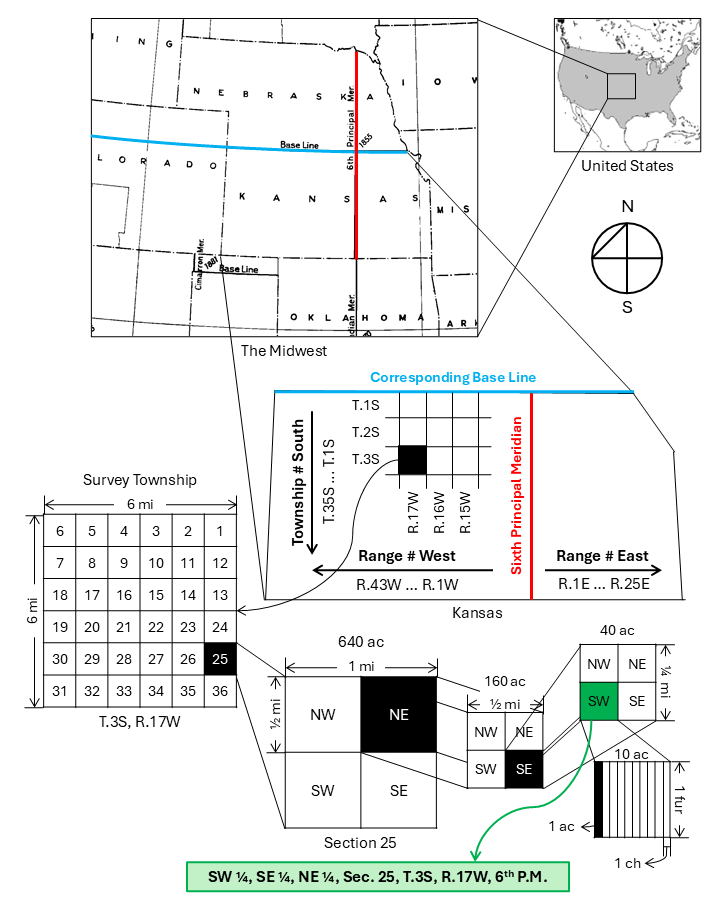 Figure 1. A description of a 10-acre land according to the Public Land Survey System (PLSS) governed by the Bureau of Land Management in the United States Department of the Interior.
Paper Size
North American paper sizes are used in the US, Canada, the Philippines, most of Mesoamerica, and Chile.
| Size | W × H | Aspect Ratio | Remarks |
|---|---|---|---|
| Junior Legal | 5 × 8 in | 1:1.6 | For small legal pads |
| Half Letter | 5.5 × 8.5 in | 1:1.5455 | For notes and planners |
| Government Letter | 8 × 10 in | 1:1.25 | For official documents |
| Letter | 8.5 × 11 in | 1:1.2941 | Standard printing size |
| Government Legal | 8.5 × 13 in | 1:1.5294 | For official legal documents |
| Legal | 8.5 × 14 in | 1:1.6471 | For legal documents |
| Tabloid | 11 × 17 in | 1:1.5455 | For posters and newspapers |
| Ledger | 17 × 11 in | 1:0.6471 | Same size as Tabloid with a horizontal orientation |
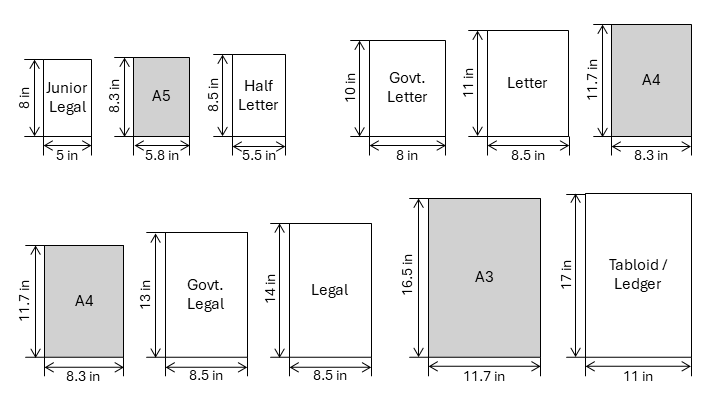 Figure 2. Comparison with A series of International Paper Size Standards (ISO 216).
3. Volume
Regular Volume
| Symbol | Unit | Divisions | Remarks |
|---|---|---|---|
| cu in | cubic inch | 16.387 064 mL | Commonly used |
| cu ft | cubic foot | 12 in × 12 in × 12 in = 1728 cu in | Commonly used |
| cu yd | cubic yard | 3 ft × 3 ft × 3 ft = 27 cu ft | Commonly used |
| ac⋅ft | acre-foot | 1 ac × 1 ft = 43 560 cu ft | For large-scale water resources |
Fluid Volume
More commonly used than dry volume.
| Symbol | Unit | Divisions | Remarks |
|---|---|---|---|
| min | minim | 1/60 fl dr, 1/80 tsp | 1 drop of water |
| fl dr | fluid dram | 1/4 tbsp | For measuring the capacity of vials |
| tsp | teaspoon | 1/3 tbsp | For culinary and pharmaceutical measurements |
| tbsp | tablespoon | 1/2 fl oz | For culinary measurements |
| fl oz | fluid ounce | 29.573 529 562 5 mL | The volume of 1 oz of water; a sip |
| jig | shot | 1.5 fl oz | The volume of a shot glass |
| gi | gill | 4 fl oz | For measuring the volume of liquor |
| c | cup | 2 gi | For culinary measurements |
| pt | pint | 2 c | For culinary measurements |
| qt | quart | 2 pt | For culinary measurements |
| pot | pottle | 2 qt | For culinary measurements |
| gal | gallon | 2 pot | For measuring fuels and household liquids |
| bbl | barrel | 31.5 gal | For measuring various liquids other than oil |
| bbl | oil barrel | 42 gal | Global standard for oil pricing and production |
| hogshead | hogshead | 2 bbl, 63 gal | For measuring alcoholic beverages |
To summarize:
(3 tsp = 1 tbsp) → (2 tbsp = 1 fl oz) → (16 fl oz = 1 pt) → (2 pt = 1 qt) → (4 qt = 1 gal)
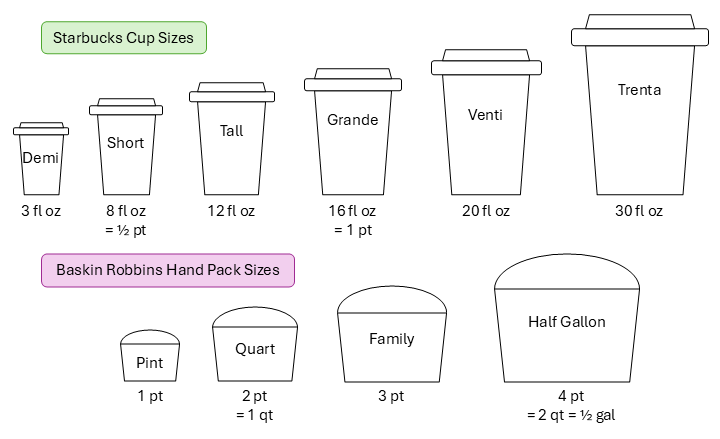 Figure 3. Comparison with the volumes of Starbucks and Baskin Robbins products.
Dry Volume
| Symbol | Unit | Divisions | Remarks |
|---|---|---|---|
| pt | pint | 33.600 312 5 cu in | For measuring small produce |
| qt | quart | 2 pt | For measuring small produce |
| gal | gallon | 4 qt | No longer used |
| pk | peck | 2 gal | For measuring produce |
| bu | bushel | 4 pk | For measuring grains |
| bbl | barrel | 7056 cu in | For measuring grains |
4. Mass and Weight
Avoirdupois
The most common unit system of mass.
| Symbol | Unit | Divisions | Remarks |
|---|---|---|---|
| gr | grain | 1/7000 lb | For measuring bullets and arrows |
| dr | dram | 1/16 oz | For measuring powder charges |
| oz | ounce | 28.349 523 125 g | For measuring small items |
| lb | pound | 16 oz | For measuring moderate weights |
| cwt | hundredweight | 100 lb | For measuring livestock and grains |
| long cwt | long hundredweight | 112 lb | For measuring vehicle weights |
| ton | short ton | 20 cwt | For measuring bulk goods |
| long ton | long ton | 20 long cwt | For measuring the displacement of ships |
Troy
Used to weigh precious metals.
| Symbol | Unit | Divisions | Remarks |
|---|---|---|---|
| gr | grain | 1/7000 lb | Same as avoirdupois grain |
| dwt | pennyweight | 24 gr | For measuring precious metals |
| ozt | troy ounce | 20 dwt | For measuring precious metals |
| lbt | troy pound | 12 ozt | For measuring precious metals |
5. Temperature
Degrees Fahrenheit are used in the US, the Freely Associated States (the Marshall Islands, the Federated States of Micronesia, and Palau), and the Cayman Islands.
The reference point of the Fahrenheit scale is the temperature of a mixture of ice, water, and ammonium chloride, and was built based on the Rømer scale. Today, the Fahrenheit scale is established using two reference points spaced 180 degrees apart: water’s freezing temperature is set at 32 °F, while its boiling temperature is set at 212 °F.
0 °F and 100 °F correspond to -17.8 °C and 37.8 °C, respectively, and the temperature range of daily life mostly falls in between.
| °F | °C | Remarks |
|---|---|---|
| 0 | -17.8 | The coldest winter day |
| 32 | 0 | Freezing point |
| 50 | 10 | Midpoint; cool weather |
| 98.6 | 37 | Body temperature |
| 100 | 37.8 | The hottest summer day |
The conversion formula from Celsius to Fahrenheit is:
\[\{T\}_{^{\circ}F} = \frac{9}{5}\{T\}_{^{\circ}C} + 32\]Questions and Answers
- Why hasn’t the United States fully adopted the metric system?
- After the Revolutionary War in the late 18th century, the US attempted to adopt the metric system from France, but was thwarted. At the time, the US Congress showed little interest in standardizing measurement systems and continued using the imperial units already in use. Today, customary units are officially used throughout the United States, with the exception of Louisiana.
- Will the United States ever be metricized?
- When pigs fly.
Leave a comment